
Constructive Design and The Psychology of Everyday Things

We love books at Vessel. Our collection is growing by the day, mostly with books on design for behaviour change. My interest in how design could change human behaviour began many years ago in New York, when I was an SVA student and a Strand Bookshop regular.

It all came together in the 1980’s when I discovered a great book on psychological principles of design that seemed closely connected to an SVA course that I had taken a couple years earlier. The book is one of the best I’ve read on human behaviour and design. It was my first book on design and human behaviour. I still have it, the original; and a few years ago I got the new edition as well. And now, as design for behaviour change is becoming quite popular, with several good publications, I still go back to that first Donald Norman book, “The Psychology of Everyday Things.” [POET]
Here's how I met the book and why it immediately struck me. It was 1988; thirty years ago. I'd been out of SVA for three years and was almost living at Strand Bookshop just reading everything on design. One day, at Strand, I started reading a brand new release, 'The Psychology of Everyday Things' by Donald A. Norman. From the first few pages I knew this book would change my life. It was motivational. It was an avalanche of design psychology that fell right into place alongside the things I had been reading a couple years earlier in one of my favourite SVA courses.
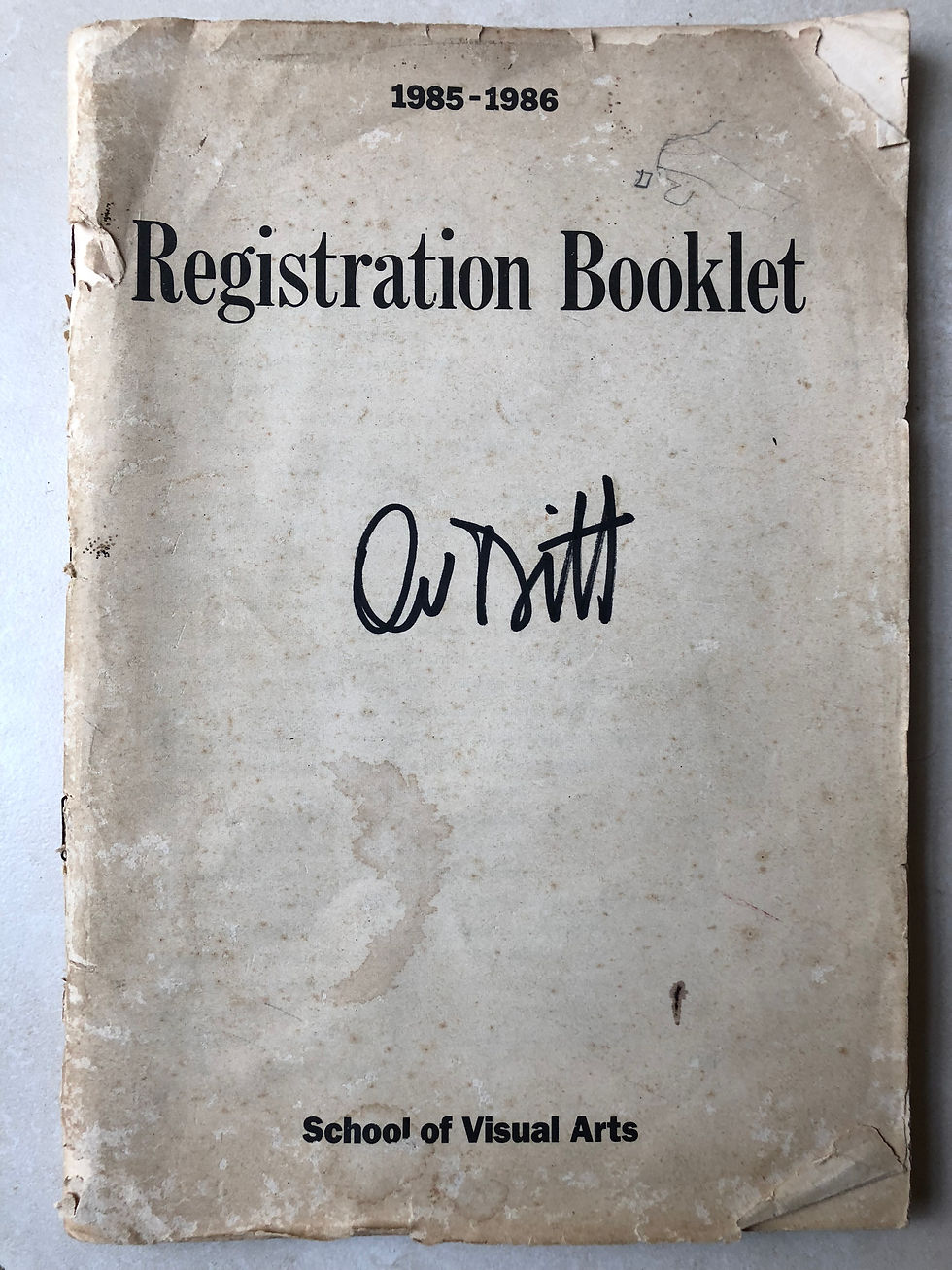
That course was Ken Deardoff’s M-322A on Constructive Design. Here are a few of the first lines taken from the 1985-1986 SVA Registration Booklet, introducing Ken’s course - "Using constructive concepts first taught at the Bauhaus, students in this course will explore the craft of structuring design. Transcending normal habits of vision, students will learn to design by seeing the relationships of one part to another. They will develop the ability to alternate figure with ground, to see design first one way then another. Through the application of perceptual psychology, students will become aware of how people look at images, and at the same time will build a visual vocabulary to organize design"
And here is just one small excerpt, of many, of how Professor Norman’s book, though published three years later, in1988, seemed to reinforce the principles in Ken’s ‘Constructive Design’. On page eight of Professor Norman's book "The Psychology of Everyday Things”. It reads, “This book is about the psychology of everyday things. POET emphasizes the understanding of everyday things, things with knobs and dials, controls and switches, lights and meters. The instances we have just examined demonstrated several principles, including the importance of visibility, appropriate clues and feedback of one's actions. These principles constitute a form of psychology - the psychology of how people interact with things."
Professor Norman’s lessons have been so fundamental to design for behaviour change that twenty years later, in 2008, Richard Thaler and Cass Sunstein used his examples in chapter five of their excellent book, ‘Nudge’, to illustrate their concept of ‘Choice Architecture’.

I got all A's in both semesters of Ken’s course. I had learnt how people see and interact with the world and how they make meaning. I had learnt how to use this knowledge to design interventions to help people make better choices.
We’ll keep our posts pretty short, like this one, and in our future posts we’ll continue to refer to the books that have helped us to be where we are today. We’ll show how we read to make links among lots of books and articles that have been published, sometimes years apart.
I’ll be posting some photos of some pretty old photocopies of Ken’s booklist and assignments from thirty years ago.
Steve


Comments