
Loving Living Landscapes

Updated: Oct 10, 2018
Whether it’s a classic painting in a gallery, an oversaturated image on a calendar, or the view through one’s window on a drive or train ride, a landscape holds a powerful place in our mind’s eye.
Landscapes are popular items in art and photography, and while there’s tremendous diversity in terms of natural habitats on earth, we do seem to favour some over others. This doesn’t mean I can’t appreciate the destitution of a desert of lava flow, but it does mean that I would probably not want to live there. Most people do seem to favour certain scenes based on very specific features.

In his book The Art Instinct, Denis Dutton expounds on these thoughts, building an extraordinary case for instinctive (genetically predetermined) aesthetic preferences. He opens the book with reference to the People’s Choice experiment, a global art project overseen by the Soviet Artists, Vitaly Komar and Alexander Melamid. It was a massive survey of viewer preferences of paintings, across 14 countries, that overwhelmingly showed striking similarities across cultures and continents.
“People in very different cultures across the world gravitate toward the same general type of pictorial representation: a landscape with trees and open areas, water, human figures, and animals. What’s more remarkable still was the fact that people across the globe preferred landscapes of a fairly uniform type…”
Of course, this would probably upset the avant-garde and postmodern sensibilities of many contemporary gallerists; landscapes are accused of being boring, philosophically unsophisticated, and even colonial in nature. But regardless of whether or not these accusations are fair, the fact remains that we love landscapes. As a species, there’s a good reason for this, the ongoing evolutionary explanation being that they represent idyllic environments for the survival of wild ancestral humans.

In a recent conversation with Dr. Stefan Uddenberg, a cognitive psychologist at Princeton University, he reflected on the findings of the People’s Choice project that “Our preferences for landscapes are quite likely baked into us, over the course of millions of years of evolution, from the Pleistocene. We love landscapes that are rich in resources that we can take advantage of… It makes sense — if you’ve got greenery you’ve got fruit. If you’ve got forests there’s going to be wild game that you can hunt. If you’ve got water there’s a huge plus there. These features are there because they provide a huge plus to our survivability.”
In this light, in the same way in which we might universally favour a smooth, rosy, untarnished mango over one which is discoloured, bruised, or green, we might favour images of these archetypal semi-wooded sceneries over dark forests or lava flows or glacial tundra, all of which we innately know might be too perilous or too extreme in heat or cold. Again, we can certainly appreciate the beauty of those places as well, but there’s a distinctly calm, almost idyllic feeling we get when we look at the right kind of landscape.
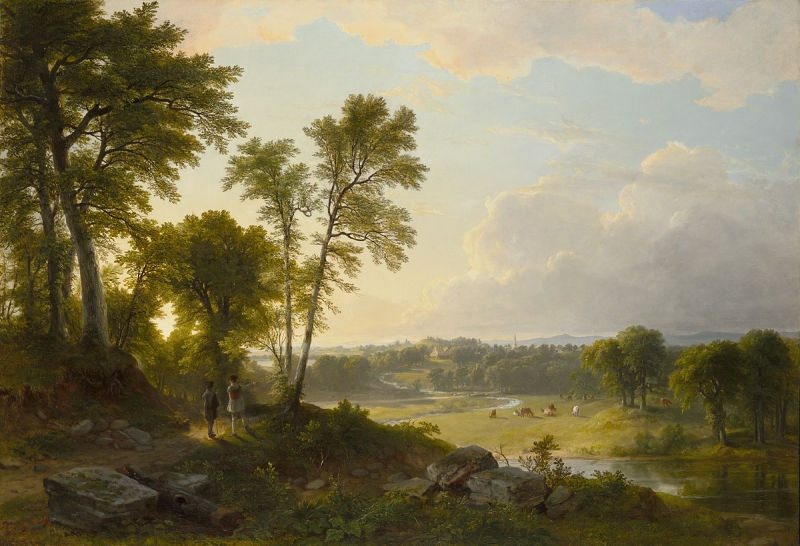
The preponderance of direct neuroscientific evidence for the way that these pictures and sceneries affect our brains suggests that we are wired to find beauty in certain scenes and images, and to appreciate beauty on the whole. In his TED Talk “The Neurobiology of Beauty”, Semir Zeki, Professor of Neuroesthetics at University College London goes so far as to say that beauty “originates in the brain, not in the works of art.”
If beauty is so central to the human experience, and these pictures of semi-wooded grasslands can have some a universal effect on us, then what might actual landscapes and urban green-spaces do for us? The health benefits are well noted,
especially when considering depression and other mental health issues. It’s worth noting too that one of the things that makes prison so unbearable is its sterility and lack of landscape entirely. The denial of a window to the world, is not just social isolation, it's scenic and sensory isolation as well.
In a place as biodiverse and naturally green as Trinidad and Tobago, we benefit from a tremendous range of ecosystem services, which if not abused and destroyed are largely unappreciated. In many parts of the country, green is seen as a handicap and a liability. But if we leverage this ecological bounty, beyond the level of agriculture or even habitat preservation, we might be able to tap into a national stress reduction reservoir, that could help insulate us from the stresses of modern urban life. At the level of preventative medicine then, if we make healthy, mindful use of parks, green yards, forest reserves, and beaches, they might help us fight cancer, diabetes, and suicide, just as well as any pill, prescription, or vaccine.
Update: Shortly after this article was posted, the National Health Service Shetland implemented "nature prescriptions" to help treat high blood pressure, anxiety, depression, and other issues.


Thanks for this excellent piece! Halfway through it, I wondered what the relative effect and/preference in our country is for landscapes involving shorelines, beaches, and coconut trees. It would be an interesting experiment, given that these too offer bounty, and I expect would have in earlier parts of human development too. I also wondered, as prison environments were referenced for the harmful effects of their aesthetic sterility, what behavioral impacts might arise from having preferred landscapes be part of the design of such institutions. What would happen if prisoners, whose potential for violence probably poses the greatest source of anxiety to prison staff, were exposed to beauty in the form of murals of preferred landscapes? Indeed, what effect would i…